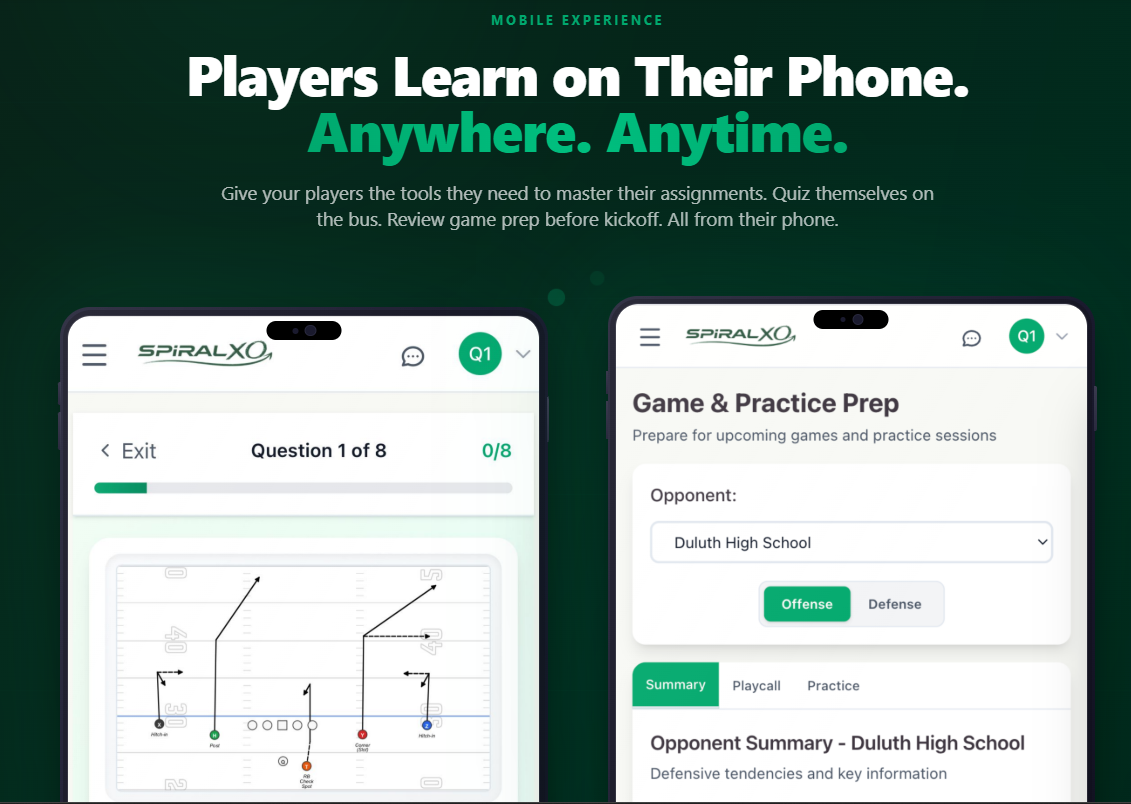
Every off-season, coaches everywhere pretty much do the same audit. They dive into the data to find trends. What really worked and what didn’t? How can we improve our playbook, game prep, and practice design? What gaps do we see in our system and how can we fix them? But there’s one major issue that we all have but never have a great solution for. Without a physical link between our playbook, scouting, game planning, and practice planning — that information stays disconnected until we manually connect the dots. This issue occurs at every program — bottom of the league all the way up to state champs. So the 2 main questions are: 1) How do we fix that? 2) What are the implications of fixing that?
This lack of connection and communication between systems is the problem SpiralXO was built to solve.
It is an all-in-one football operations platform built specifically for high school and small college programs — this is not a generic team management app with football features slapped in there. And it’s not another tool to pile onto the already overcrowded list of software most staffs are juggling every week: Hudl, Google Drive, Docs, Sheets, PowerPoint, group texts, and live-tagging.
SpiralXO replaces that patchwork with one connected system. Your playbook, player quizzes, practice planning, scouting, game planning, in-game analytics, calendar, staff and parent communication — all in the same place, all talking to each other. When your playbook directly communicates with your scouting information, call sheet, practice plans, and in-game analytics, something fundamentally changes in how well prepared you are for game day.
SpiralXO was built by coaches Justin Sottilare and Chandler Bell, who got tired of software making the job harder instead of easier. Here are seven specific ways their solution turns a bad team into a competitive one — and a good team into a powerhouse.
Way #1 — Call Sheet Generation: A Winning Game Plan in Seconds
Ask any coordinator how long it takes to build a quality call sheet and the answer is usually “too long.” Hours of cross-referencing your playbook against the scouting report — figuring out how they will align to your base looks, which runs exploit their alignment tendencies, which plays belong in your third-and-medium package. The thinking is good. The repeated manual process every week, for years on end, is not. At a certain point, there are other levers you could be pulling that have a bigger impact on your program.
SpiralXO does that cross-referencing for you. Feed in your system and your opponent’s scouting data and the platform surfaces the exact play calls that match up best in each situation — instantly. You review, adjust, and confirm. The call sheet is built around your decisions and your terminology, not a generic template. What used to take half a day now takes minutes, which means your staff spends that time actually coaching.
→ Your system + their tendencies = a game plan in seconds.
Way #2 — Scouting Integration With Hudl: From Raw Data to Ready Report
Your staff is already spending hours tagging film in Hudl every week. SpiralXO connects directly to that work. Import your Hudl data and the platform breaks it down automatically — formations, tendencies, down-and-distance, personnel groupings — organized into a clean scouting report that is ready to act on immediately. No rebuilding. No reformatting. No copy-pasting into a Google Doc.
But here’s what separates it from any spreadsheet: your players get instant access to the scouting information themselves, right in their accounts. Attach video clips and images so they’re not just reading numbers — they’re seeing the actual looks they’ll face on Friday night. When your players walk in already knowing what the opponent does, the install meeting changes entirely.
→ Players see the scouting report. Not just coaches.
Way #3 — Player Learning: Everyone Prepared Before Friday Night
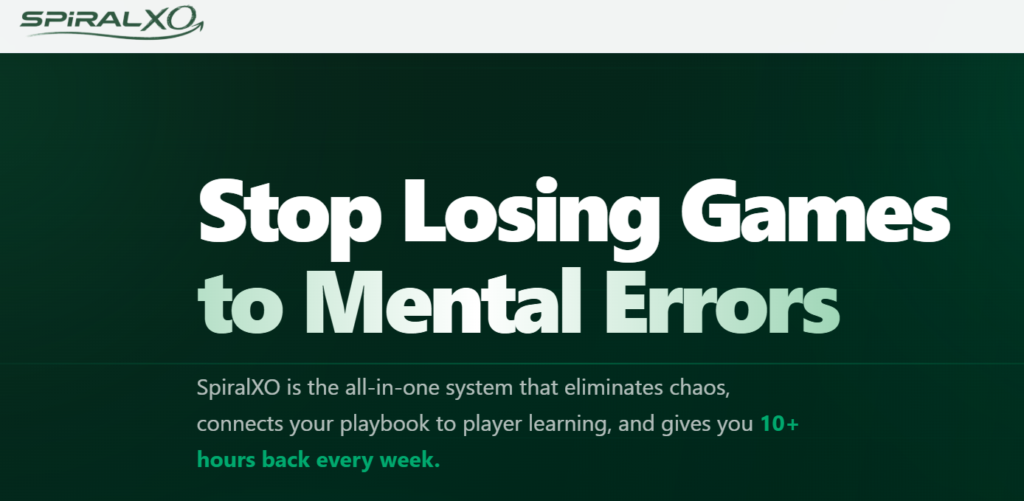
Most programs send a PDF install, hope players open it, and find out who actually studied when it matters — during the game. SpiralXO replaces that uncertainty with accountability. Assign an install and track exactly who completed it, who understood it, and who needs extra attention before they ever step on the field. Not after a blown assignment in the second quarter. Before.
Players quiz themselves using assigned quizzes or auto-generated ones built directly from your playbook. They draw their own assignments and the system scores their accuracy — a 14-yard comeback route run at 8 yards is a bad score, and both the player and coach know it immediately. When players understand their assignments before Friday, mental errors stop being a mystery and start being a solved problem.
→ Fewer mental errors. No more surprises on Friday night.
Way #4 — Live In-Game Analytics: Stop Guessing. Start Knowing.
One coach inputs play data live on a phone or tablet during the game — formation, play type, result. That’s it on the input side. On the output side, every coach on your staff immediately sees real-time tendency charts, success rates by situation, and intelligent suggestions for what your opponent is likely to run next based on what they’ve shown so far.
The coaches who win fourth-quarter games aren’t always more talented. They have better information, faster. No more halftime adjustments built on a hazy memory of what happened in the first quarter. No more play-calling by feel when the data is sitting right there. Live in-game analytics give every program that same edge — without needing a full analytics department to run it.
→ Real-time data for every coach on staff. Not just the booth.
Way #5 — Scout Card Generation: Cut the Time in Half
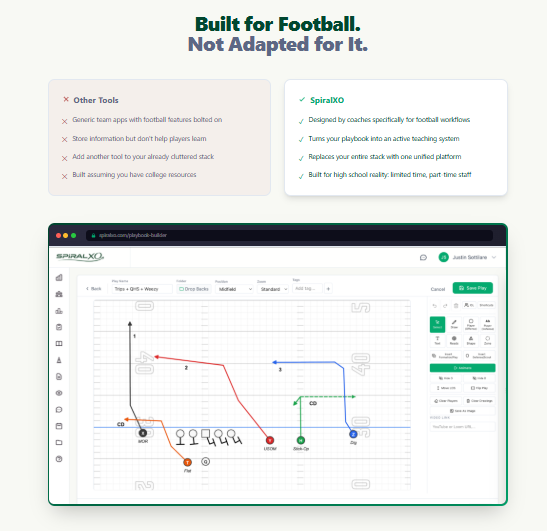
Scout cards are one of those tasks that every program knows has to get done and almost every program hates doing. Building them from scratch each week — using the opponent’s terminology, reformatting looks, printing and distributing — devours prep time that should be going somewhere else.
SpiralXO connects scout card creation directly to your team’s playbook and your own terminology. Templates make the first week faster, and the library grows every week after that — the more you build, the more the system has to pull from automatically. Coaches using SpiralXO cut scout card generation time significantly, and unlike a manually built card, these link directly back to the scouting report your players already have in their accounts.
→ Faster scout cards that connect directly to player prep.
Way #6 — Instant Post-Game Breakdown: Export to Hudl and Move On
The final whistle blows and the clock toward next week starts immediately. SpiralXO lets you export your entire game log — every play, every call, every result tagged during the game — directly to Hudl or QwikCut in one click. No manual re-entry. No rebuilding data that already exists. By Saturday morning, your staff has everything needed to evaluate what worked, identify what broke down, and walk into the first team meeting of the week with data-driven answers.
That speed compounds. The faster your post-game process, the more time you have to prepare for the next opponent. Over a full season that advantage — arriving at each week’s prep with more time and better information than the program you’re about to play — is where consistent winners separate themselves from teams that are always just catching up.
→ One click. Full game log. Straight to Hudl.
Way #7 — Last-Minute Changes Reach Every Player Instantly
Friday morning. Your starting corner is out. In most programs, what follows is a scramble — updating the depth chart in one place, texting coaches in another, hoping the right players find out in time through a group chat that half of them have muted. It is a minor crisis that plays out in some form almost every single game week.
In SpiralXO, a depth chart update takes seconds and pushes through the built-in messaging system immediately. Every player receives a personalized view showing only what is relevant to their position and role — no noise, no confusion about what changed, no player showing up Friday night with last week’s information. It is a small thing that, when it goes wrong, costs you on the biggest night of the week.
→ Right information. Right player. Right now.
“The difference between a program that wins consistently and one that wins occasionally isn’t always talent. It’s how well the system behind the coaching works — week in, week out, from August through the playoffs.”
See It Connected
Watch a quick walkthrough of SpiralXO — built for high school and small college programs. No pressure. See if it’s what your program has been missing.
Watch a Quick Demo → spiralxo.com – Starting at $1,500/year · Personalized setup included.
About the Author