I have served as an expert witness in approximately 35 cases over the last decade. This work has been eye opening, and it has been rewarding. I was first sought after to serve as an expert in a football injury case, the lawyers were intrigued by my background, they found me right here, on my website!
This case we will look at today was very sad for me to work on, as a student-athlete’s life was forever altered because of a preventable multiple concussions that were sustained during a JV football game, because of a coach who had NO business coaching.
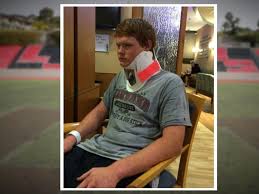
The traumatic brain injury was so bad that he had to be transported by ambulance right from the sidelines, and immediately into surgery where they cut his skull open, to relieve the blood building up in his brain.
The names of the school, the coaches, and the players are redacted for this article. However, if you want to watch a short video about this case, you can do so below. It is one of the most well documented concussion cases in California, and received a lot of media attention.
I have reviewed the game film from the October 16, 2014, junior varsity football game between La Jolla High School and Point Loma High School, along with supporting depositions, school reports, and relevant concussion protocols. My analysis focuses on the case of player John “Trey” Enloe III, #60, who sustained a concussion during the game. Based on my professional expertise, I opine that JV Head Football Coach (Redacted) acted recklessly by failing to adhere to established standards of care, thereby increasing the inherent risks of football and contributing to Trey’s exacerbated injury. This opinion is grounded in video evidence, witness testimonies, and regulatory guidelines from the California Interscholastic Federation (CIF) and National Federation of State High School Associations (NFHS).
The game film, though missing the initial kickoff where Trey reported his first injury, provides clear visual documentation of Trey’s deteriorating performance, indicative of concussion symptoms. Starting at 6:01 in the first quarter, Trey’s actions deviate markedly from his described “fiery” personality, as noted by teammate John Boehme. At 1:50 on the DVD, Trey kicks the ball out of bounds after a touchdown—a potential missed assignment that could signal early cognitive impairment. More critically, at 2:07, Trey’s head strikes the turf hard during a tackle, an impact that alone could cause or worsen a concussion. Post-impact, Trey shows no emotion after recovering a fumbled punt at 3:02, a play that should elicit celebration from an engaged player. This lack of emotional response is a red flag for neurological disruption, such as confusion or disorientation, common concussion signs per NFHS guidelines.
Throughout the first half, Trey’s play regresses. On offense, he fails to sustain blocks, moves sluggishly with slow feet, and shows minimal second effort—hallmarks of impaired focus and balance. At 7:40, he ignores a teammate’s big play, and at 7:54, he remains emotionless after contributing to a sack. By 9:23, after a touchdown, Trey exhibits zero hustle, and at 9:35 during an extra point, he is the slowest lineman, failing the basic first step and getting beaten badly. These lapses are not mere fatigue; they indicate a player unable to perform fundamentals, increasing his vulnerability to further hits. At 10:05, as defensive end, Trey only retreats backward, showing no effort to advance. Trey was the center, and his snaps become erratic: at 11:07, the ball goes to the quarterback’s feet; at 13:35 and 13:56, snaps are low or into the ground, with Trey losing balance repeatedly.
The pivotal moment occurs around 12:13 in the second quarter, during an extra point where Trey is driven 10 yards backward, appearing to merely go through motions. This play encapsulates teammate testimonies that “Trey wasn’t Trey.” Immediately after, Trey complains to Head JV Football Coach (Name redacted) of not feeling well and requests removal from the game. Depositions from four different players corroborate this: Trey hobbled to the sideline, appeared dizzy, and explicitly said he couldn’t continue. (Player name 1 redacted) heard Head JV Football Coach (Name redacted) respond, “I don’t have time for this bullshit. Suck it up and get back in there,” forcing Trey back despite pleas to get a break. (Player name 2 redacted) noted Head JV Football Coach (Name redacted) aggressive yelling, and (Player name 3 redacted) recalled Trey’s sluggish kickoff post-interaction, leading to a return touchdown and further berating from Head JV Football Coach (Name redacted) , as overheard by Asst. Coach (Name redacted).
Trey was the kicker as well, and this deep kickoff at 12:30, meant to be a squib, was a direct failure under duress. His brain simply wasn’t functioning as it should. Head JV Football Coach (Name redacted) decision violated CIF Bylaw 313 (effective May 2010), which mandates immediate removal of any athlete suspected of concussion, prohibiting return without clearance from a licensed health care provider. NFHS rules since 2010/2011 require removal for signs like headache, dizziness, confusion, or balance issues— all evident in Trey’s self-report and observed behavior. AB 1451 (effective January 2013) further requires biennial concussion training for coaches, which Head JV Football Coach (Name redacted) should have completed. His failure to inquire about Trey’s symptoms, send him to the athletic trainer, or heed warnings from players like (Player name 1 redacted) and (Player name 3 redacted) constitutes recklessness—a disregard for consequences that heightens football’s risks.
Halftime discussions, as deposed by (Player name 5 redacted), reveal team speculation about Trey’s injury, including ambulance rumors and blame toward Head JV Football Coach (Name redacted) for overplaying him. In the second half, Trey’s decline accelerates. The first snap at 19:28 is at the quarterback’s feet, followed by balance losses at 19:52, 20:15, and 22:29. Offensive plays show persistent block failures with no second effort, distinguishing this from fatigue, as Trey occasionally runs fast in reaction but lacks engagement. Immediately following the Varsity practice, and attending the JV game, The Head Varsity Coach, with 20+ years of experience, noticed Trey’s “wobbly legs” immediately upon observing the third quarter, stating, “You know when someone is not right.”
The Head Varsity Coach’s deposition underscores Head JV Football Coach (Name redacted) failures: not “knowing his player” as trained, violating protocol, leading to Head JV Football Coach (Name redacted) suspension. The Head Varsity Coach admitted to Trey’s parents that Head JV Football Coach (Name redacted) confessed to the profane dismissal and forcing re-entry. School administration confirmed Head JV Football Coach (Name redacted) put Trey back after his plea to leave the game, using profanity witnessed by players, and yelled post-mistaken kick. Player observations align: (Player name 1 redacted) saw sluggishness; (Player name 2 redacted) heard dizziness reports; (Player name 3 redacted) noted wandering eyes; (Player name 4 redacted) said Trey “wasn’t really there”; (Player name 1 redacted) observed team-wide concern; (Player name 5 redacted) described “out of it” eyes; (Player name 2 redacted) saw hobbling; (Player name 2 redacted) noted an unhealthy face.
In my expert opinion, Head JV Football Coach (Name redacted) actions breached the standard of care. He failed to: (1) ask about Trey’s condition; (2) recognize signs like self-reported unwellness and missed assignments; (3) evaluate via trainer; (4) listen to peers; (5) prioritize safety; (6) follow NFHS/CIF protocols. This recklessness exposed Trey to further concussive events, avoidable had removal occurred. Football inherently risks contact, but coaches must mitigate via protocols established post-2010 awareness campaigns. Head JV Football Coach (Name redacted) increased these risks, potentially worsening Trey’s long-term outcomes, as second-impact syndrome can exacerbate brain trauma.
Evidence is overwhelming: video shows regression; testimonies confirm interactions; timelines highlight ignored mandates. Had protocols been followed, Trey’s injury might have been limited. Coaches bear fiduciary duty to athletes’ well-being—Head JV Football Coach (Name redacted) abdicated this, warranting accountability. My opinions are based solely on provided materials, emphasizing prevention through vigilance.
Chris Fore is a veteran Administrator, Athletic Director, and Head Football Coach from Southern California; he currently serves as a Principal. He has written four books and produced coaching manuals, available at EightLaces.org. Both schools where he served as Athletic Director set school records for championships won in a single school year, and were recognized for both sportsmanship and academic excellence. Fore holds a Master’s in Coaching and Athletic Administration and multiple education credentials. A Certified Athletic Administrator, he served as President of the California Coaches Association (2018–2021) and has held various other leadership roles in several different organizations. A sought-after speaker, Fore has contributed to national sports publications and appeared on radio and podcasts. He also serves as an expert witness in athletic lawsuits. Follow him on X!